Friday, June 25, 2010

Room 7 talks about Yeast

Room 7 children have been making 'Comic Life' presentations showing, in their own words, what they have learned during science the last few weeks. Have a look by clicking on 'Class of 2010' link to the left.

Please leave a comment! The children love to read these.

Thursday, June 24, 2010

Room 7 digi-kids


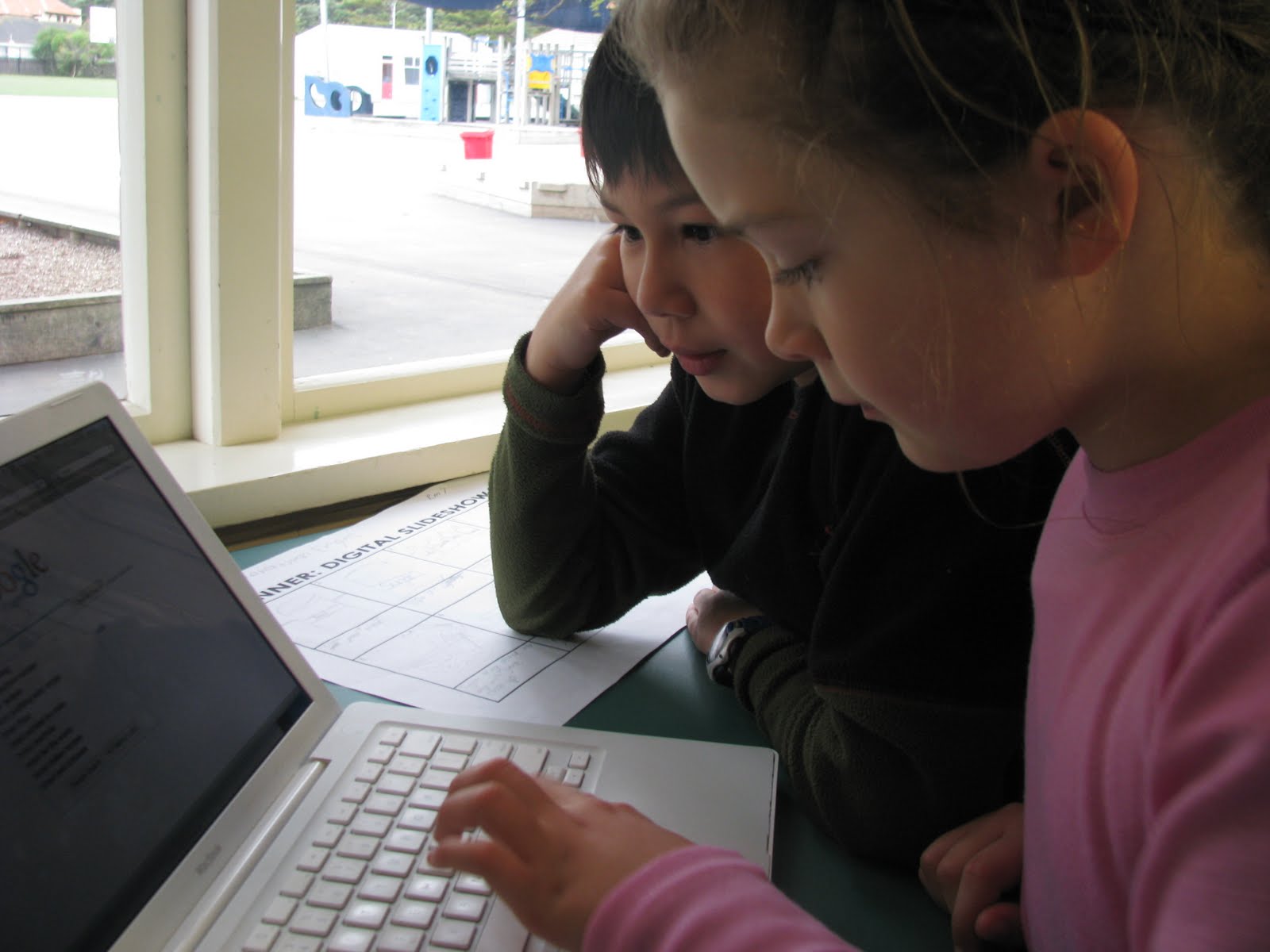
Jonathan and Ella are 2 digi-kids in Room 7 who have been working with Mr Skilton and myself to make a slide show on the bread-making process.

These 2 digi-kids have taken complete control, from start to finish, making the slideshow. They developed a storyboard, included a storyline, took the photos needed to illustrate the story, and imported the photos into iPhoto to use in the slideshow. Well done Ella and Jonathan!

As soon as the slide show is completed, it's going to be shown at assembly! I'll also make sure it is blogged right here, on Room 7's blog!

The photo shows Jonathan and Ella working hard on their slideshow.

Wednesday, June 16, 2010

Making Bread


Miss Gandhi and Mr Dobson have been busy teaching Room 7 about starch, yeast and CO2 and how they can be used to make bread.

On Tuesday each table group made a loaf of bread and ate it at the end of the day. It was delicious!

Ella and Jonathan,
who are our class photographers, took these photos of the process we followed:

Firstly the yeast needs to be 'excited' by feeding and watering it. We fed the yeast sugar and let it soak up warm water.


We mixed flour and sugar together


we added warm water which helped the starch in the flour swell up and become sticky.

Next we added the yeast mixture and kneeded the bread.

The bread dough needed to be kneeded for a long time until it became elastic


We left the kneeded dough in the sun. The warmth of the sun helped the yeast grow and release CO2. The CO2 gas made the bread dough puff up.
We put the bread dough in the oven and baked it for 40 minutes.

YUM! Who would have though starch, yeast and CO2 could make something so delicious!

Friday, June 11, 2010

The changes that starch and yeast goes through


Over the last two weeks we have explored what changes starch and yeast can go through.

We have discovered that starch and yeast stay inactive (not doing anything) until they are excited/activated. Warm water was a way we activated both the starch and the yeast.

We discovered that starch swells up and becomes sticky when it is activated.

We discovered that because yeast is a living organism, it needs to be fed as well as watered, before it activates (comes alive).

Once the yeast has been woken up by the warm water, and has fed on the sugar, it starts releasing CO2. The CO2 made all the bubbles we could see. The yeast underwent a chemical change.

We experimented by mixing yeast, sugar and warm water together, then added that to a flour (starch) and water mixture, to see what would happen.

Some of us thought the mixture turned into something resembling pizza dough.

Friday, June 4, 2010

Veggie Patch programme


The Year 3 and 4's have enrolled in the McCain School Veggie Patch programme. The programme involves collecting barcodes from McCAIN frozen vegetable and McCAIN Purely Potato packs and sending these to school. Teachers will collect the barcodes, which can be redeemed for a whole load of garden supplies.

By clicking on the picture above, you can visit the McCain Veggie Patch website and browse the various items we could purchase, using the barcodes.

Your family can get in behind the Year 3-4 garden project by collecting McCain vegetable barcodes and sending them to school- as simple as that!

Thursday, June 3, 2010

Introducing Vaishally Ghandi


Hey all,

My name is Vaishally Gandhi, and I would just like to introduce myself as the student teacher who will be in Room 7 until the end of Term 2! My time at Muritai is my final section as part of the four year primary and secondary Bachelor of Teaching conjoint programme with a Bachelor of Commerce and Administration. So far I have been inspired by the passion that learners, staff and the wider community bring towards the learning which is occurring at Muritai, and I will endeavour to add to this community of rich learning!

If you do have any questions about your child’s learning during my time here, please feel free either to pop in at the beginning or the end of the school day or to send me an email at gandhivais@myvuw.ac.nz

I look forward to working with you

Vaishally Gandhi

Tuesday, June 1, 2010

Origami Homework

HI Everyone,

Here is the link I promised:

http://www.origami-instructions.com/origami-for-kids.html


Make sure you scroll DOWN the page and click on the little pictures.

Don't click on the writing at the top of the page because they are ADVERTS!

Tuesday, May 25, 2010

The Mysteries of Harris Burdick


For the last few weeks we have been learning how to use the 4 features of narrative writing (setting, characters, complication, resolution) to full effect in our writing.

This week we used some motivational pictures from the book "The Mysteries of Harris Burdick" by Chris Van Allsburg to write about.

We then recorded parts of our stories using Vocaroo, an online recording widget.

Click on the Class of 2010 link to the right. Then click on each students name to hear them read part of their "Mystery" story.

Wednesday, May 19, 2010

Learning about chemical reactions

The main investigation this term in Room 7 is on the 3 states of matter. We have been learning, or will be learning about:
  • What the 3 states of matter are;
  • what makes them different;
  • what can make one type of matter change into another type of matter;
  • what types of reactions are temporary (physical change) or permanent (chemical change)


Recently we explored how solids and liquids can interact, cause a reaction and change into a gas. We discovered that this sort of reaction is permanent (it can't change back) so it is called a 'chemical reaction'.


After we repeated the 'demonstration', we made a modification to the original experiment, made a hypothesis on what we think would happen, and conducted an experiment to find out what effect our changes would make.

We learned that to make this type of chemical reaction, we need to mix an acid with a soda (carbonate). The chemical reaction releases the Carbon Dioxide ( CO2) that was inside the soda.


The released CO2 made the balloons inflate!

Friday, May 7, 2010

Performing Arts presentation


For the last few weeks on a Thursday, Room 7 have been working with our
Performing Arts teacher, Mrs Hooke
,
learning all about different dance styles and techniques. Room 7 will be presenting the dance to the school at this Friday's assembly.

Wednesday, May 5, 2010

Hokey Pokey

On Monday afternoon, we started our Science investigation for the term - Temporary and Permanent Changes. We firstly looked at Chemical reactions, and what can make them. We looked at the 'fizz inflater' video on the Year 3-4 Science wiki...


... which showed that an acid (vinegar) and a carbonate (baking soda) can make a gas (carbon dioxide, Co2) if mixed.

Can we make Co2 in other situations?

We made Hokey Pokey to find out. We heated Golden Syrup in a flask until it bubbled. We then mixed in baking soda and stirred as the mixture frothed up. The frothing was the baking soda releasing all of it's carbon dioxide gas.

Due to popular demand, below is a Hokey Pokey recipe much better than the one we used on Monday!

Ingredients

5 Tbsp Chelsea White Sugar
2 Tbsp Chelsea Golden Syrup
1 tsp baking soda

Method

Put Sugar and golden syrup into a saucepan. Heat gently, stirring constantly until Chelsea Sugar dissolves. Increase the heat and bring to the boil. Boil for two minutes. Stir occasionally, if necessary, to prevent burning. Remove from heat. Add baking soda. Stir quickly until mixture froths up. Pour into a buttered tin immediately. Leave until cold and hard. Break into pieces.


Special thanks to Edmonds for use of this recipe.

Tuesday, April 27, 2010

PIRATES!

Sometimes writing about things we don't know much about can be tricky. That's why generating plenty of ideas first, before any story writing happens, is very important.


To help motivate the class learn how to write an effective narrative, I chose a 'pirate' theme for the writing to be centred around. The only trouble is, not everyone knows a lot about pirates.


So I found 4 very descriptive poems about pirates. In groups, as they read the poems, the children wrote on sticky notes 3 'facts' about pirates they figured out by reading each poem.


After the poems had been read, we had over 30 post-it notes filled with pirate facts. Next, each group looked at their facts and sorted them into main groups such as 'things a pirate might say' or 'things a pirate might do'. They then cut them up and glued them onto a big chart on the classroom wall.


This is now our "pirate story' display, where the children can go to get ideas when planning and writing their pirate story, which we will start later in the week. It was a visual, motivating activity to get the class thinking on a certain 'theme', where their prior knowledge might not have been great.

Monday, April 19, 2010

Eastbourne War memorials


Today we looked at two war memorials here at school. The first memorial we looked at is the Pohutakawa tree on the corner of Rata and Orua Street. Did you know this was the first war memorial for the Gallipoli campaign in New Zealand?


The next war memorial we looked at was the Memorial Gate under the flag pole. We noticed that some names had poppies besides them, and realised these soldiers were the ones who died.

Wednesday, April 7, 2010

Yummy Wraps!


As a finale to the 'healthy food choices' part of Term One's "How we learn' inquiry, we made yummy wraps for lunch. The success criteria for each wrap was 'did I include ingredients from the main food groups, using the 'eat more of, eat less of, eat only a little of' guide.

That's it for Term One! It was only eight and a half weeks long. Have a wonderful Easter and April school holiday Room 7. See you next term, ready for ANZAC DAY (see the new link to the right!)

Tuesday, March 23, 2010

Beth's Monarch Butterfy hatches!


We have been watching Beth's chrysalis for over a week now. Yesterday we noticed that it had turned black and we could see orange wings inside the chrysalis. Today at about 10.00am we suddenly noticed the butterfly had hatched and was pumping blood into its wings, ready to fly away! Beth and her friends put the butterfly on a swan plant in the junior courtyard, and just before lunchtime it flew away.

Friday, March 19, 2010


This movie was contributed by Stuart Stock who is one of our parents. We had a great time last Friday holding the Y3-4 swimming sports. It was a bit cloudy and cold- who would have thought after such an amazingly warm sunny week? Never mind- it was a wonderful morning filled with children trying their very best. The house relay was a big highlight... go Cook!

Wednesday, March 17, 2010

Using digital objects to learn new things


In Room 7 we have a digital data projector that is used (pretty much) every day in different ways. Sometimes we use it to look at and interact with digital learning objects. This week as part of our Body Science study, we have been exploring how the digestive system works, and today we used a digital learning object that helped us learn the names of the different parts of the digestive tract. Tomorrow we plan to use another digital learning object, to help us learn what certain organs along the digestive tract actually do with food after we've swallowed.

You can see these digital learning objects by clicking the appropriate links below the "How WE Learn" sidebar to the right.

Wednesday, March 10, 2010

Sea Week

This week is "Sea Week" across New Zealand. Seaweek is an annual event run by the NZ Association for Environmental Education that allows New Zealanders to come together and celebrate the sea. Since we live in Eastbourne, the sea is a big part of our daily life. It only seems right we celebrate Sea Week!


For maths we looked at scale drawings of different sea animals, then we used estimation skills to calculate how big these sea animals would be in real life. We then went outside and drew them! Did you know that some jellyfish can grow to be over 10 metres long?

Tuesday, March 2, 2010

We've been practising our mihimihi...

Last week we were practising our mihimihi (greetings) and we were able to record them. This week we will look at our recordings and see what we need to do to improve them!