Thursday, July 19, 2012

Sock Puppet Monkey Pictures


In Art this term we are exploring the technique of 'multimedia'. We have learned that 'multimedia' means using more than one art technique in a piece of art.

As an exploration of what multimedia might look like, we have plunged headfirst into our first piece of art for the new school term, "Sock Puppet Monkey" pictures.

We found out that 'sock puppet monkeys are a popular 'folk art' toy in North America. We don't have this tradition in New Zealand, but apparently in the USA and Canada, many children will own a sock puppet monkey.


Our pictures used the idea of painting a sock puppet monkey, then decorating the monkey with clothes. One compulsory element was to make and  include  a pompom.

Here are some pictures of us making our sock puppet monkey pictures...


Saturday, July 7, 2012

This is our Planet


Hope you are enjoying the sunny weather during the second week of your winter school holiday! I bet your parents are happy that you can get out of the house and play outside!

I found this and thought you might like it. Enjoy!

Credit: http://blogs.discovermagazine.com/badastronomy/2012/07/06/this-is-our-planet/

Thursday, June 28, 2012

"Invent a game" Homework

Room 7 have been spending some time each night for homework, inventing a game that teachers others a new skill or knew knowledge.

This week, students have been bringing their games to school and explaining to the class what their game is, and what it will teach them. Then, they have been choosing some friends to play the game and test out it's effectiveness!

Here are some photos taken during the week...


Thursday, June 21, 2012

Matariki

Today is the start of Matariki.

Matariki is the Maori New Year. In New Zealand, it is becoming more and more popular to celebrate Matariki. There is talk that it may soon become a public holiday.

In Room 7 we have learned that Maori New Year begins when the Matariki stars (Pleiades) first appear over the horizon each year. This was a sign to start the annual planting of the crops that would grow through spring and summer.

Matariki was celebrated in pre-pakeha times by feasts/Haangi, celebration and reflection on the year that has been. The children celebrated Matariki by playing games.

On Tuesday, Mr Chadwick at Kapahaka, taught us how to play "Kite"- "Too see".

To play "Kite"  two players each hold a Ki Paua in one of their hands.  They stand some 5 or so metres apart in a defined area.  They then close their eyes or are blindfolded.  Each player must rattle their Ki Paua vigorously with each step.  They can remain stationary but must still rattle their Ki Paua vigorously every 5 seconds or so.  The object of the game is to work your way into the vicinity of your opponent so that you can grab or tag them before they get you!

Friday, June 15, 2012

Whale Migration Mystery

This week we have been learning about Whale migration. We've found out that Humpback Whales spend much of the year in the Southern Ocean around Antarctica, feeding on krill and other zooplanktons. Then, they migrate up past New Zealand to the warm tropical waters of the equator to give birth to baby whales. They stay in the warm waters until the baby whale (called a 'calf') is fat enough with BLUBBER (word of the week!) to survive the cold waters, before migrating back to Antarctic waters.

Mr Dobson was wondering though, if Antarctic waters are so cold....

...why doesn't the Antarctic Ocean just freeze?

To find out why, Room SEven conducted an experiment using ice.

First, we measured the temperature of ordinary, fresh water ice. We found that it was close to, or exactly, 0 degrees celcius. This is the temperature that fresh water freezes.


We then added water and salt to the ice  to make a salty water solution and continued to take temperature measurements. 


The temperature DROPPED even more! Some groups reported temperatures of minus 10, 12 and even -13 degrees!!!

We concluded that, although fresh water freezes at 0 degrees celcuis, salt water freezes at a MUCH lower temperature.

So that's why the ocean around Antarctica isn't frozen solid!


Friday, June 1, 2012

Island Bay Marine Education Centre visit

Our recent trip the the Island Bay Marine Education Centre was fantastic! Here are some highlights!

Hopping from rockpool to rockpool!


I wonder what we have found?


SHRIMP!!!


A beautiful orange crab

Mr Dobson with Saxon and Josh

Cam in the whale pot!

The 'touch-tank'

The camouflage crab

What do mammals need to survive?

We have been investigating what all mammals need to survive. We learned that mammals need
  • food
  • air (oxygen)
  • water
  • a heat source
And all mammals convert the above into energy to fuel their bodies. After that fuel is used up, the mammal produces a waste product.

To prove that this was true, the children in Room 7 ran a science 'experiment'. Rather than experimenting on a live mammal, we used yeast, a living organism, instead.

We put Yeast in a small water bottle. We feed the yeast food (sugar), we gave the yeast air and water, and gave the yeast a heat source (the radiator).  We then put a balloon over the neck of the water bottle.

This is what we saw happen:


What was filling the balloons?

We concluded it was the waste product from the yeast, as it converted the food, water, air and heat into energy. The waste product was carbon dioxide, and it smelled like bread!


Friday, May 4, 2012

Why Don't Whales Sink?

This week, Mr Dobson posed the question "Why don't Whales sink?". He thought they should. After all, many whale species are HUGE and HEAVY! He thought they should all sink to the bottom of the ocean.


We had much discussion about this. Some of the ideas and reason that Room 7 came up with were
  • Blubber. The blubber around a whales body helps it to float
  • Air. Whales are air breathers and each time they take a breath, it helps them to float.
  • Flippers and Flukes. The whale has evolved strong flippers, and a whale's fluke (tail) helps it to push upwards in the water.
Mr Dobson then proposed that it may also have something to do with sea water. Ever heard of the Dead Sea? The 'Dead Sea' is a lake where people float on the surface of the water, and can't sink. 
This is because the water in the Dead Sea is dense with salty minerals, a lot like sea water. The water out of a tap (fresh water) is less dense than salty water. 

Maybe heavier objects float better in salty water?


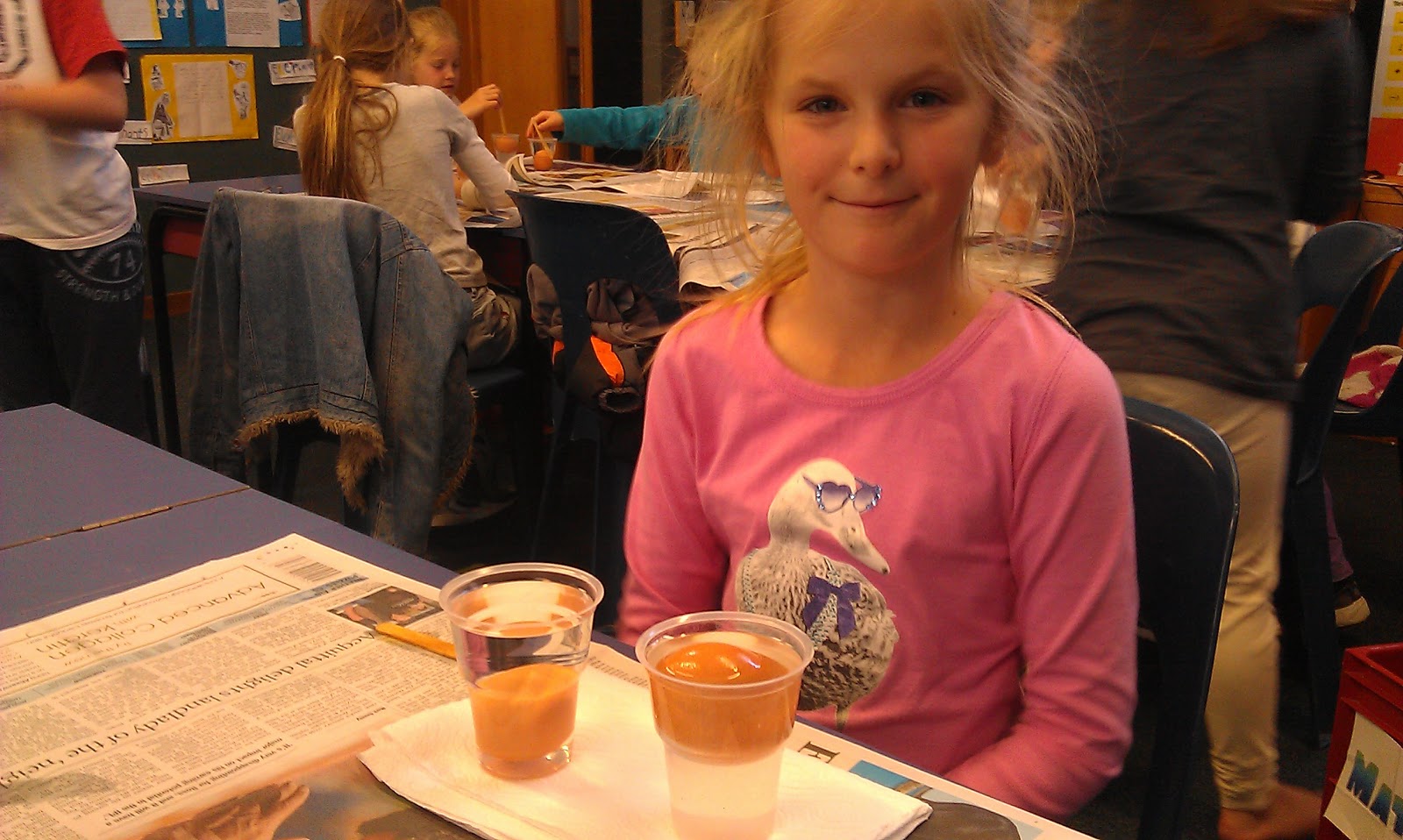
To test this out we We tried floating  raw eggs (whales ) in both tap water and salt water to see if there was any difference.

  
We put the eggs in cups with tap water and salty water .

In tap water the egg sank and in salty water the egg floated.


This seemed to prove that object (like whales) float better in denser water (like the ocean) than in fresh water.